
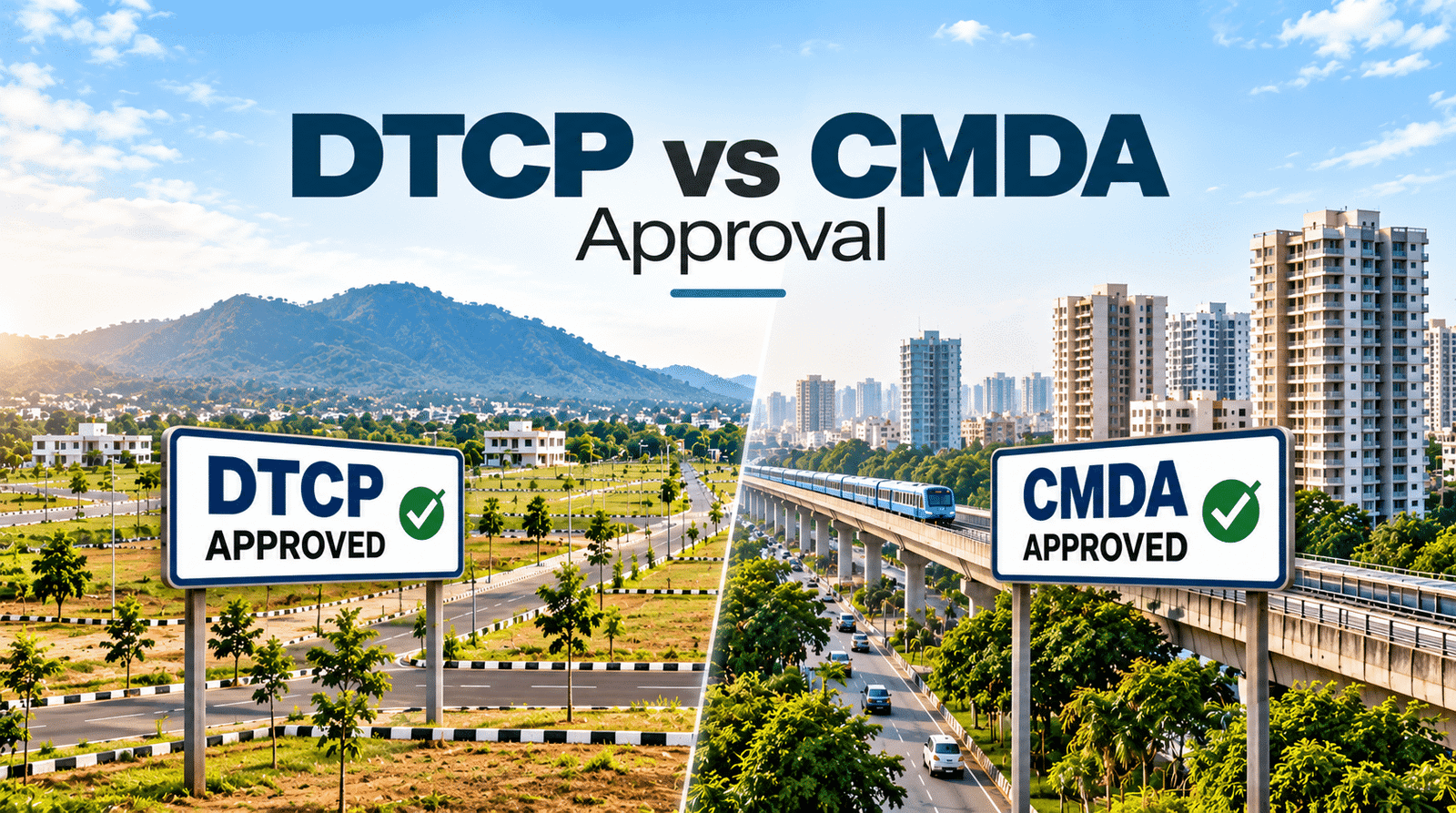
Introduction
Property buying is a big decision. It takes time and effort from your end to accumulate funds for it. That is why it is important to think beyond the looks and even price before finally deciding.
While shopping for your property in and around Chennai, you might find terms such as DTCP Approved and CMDA Approved in property listings. However, these terms could confuse you if you are a first-time home buyer. You might think one is better than the other or wonder why different properties have different planning approvals.
In reality, the answer is quite simple. DTCP and CMDA are planning authorities applicable to different jurisdictions. The planning authority depends upon the place of property.
Having this information can help you ask the right questions regarding planning and documents.
1. DTCP Means What?
DTCP stands for Directorate of Town and Country Planning.
It is the planning authority for regulating the land development in various parts of Tamil Nadu. The planning is applicable in different towns, municipalities, villages, and other areas of developing regions apart from Chennai Metropolitan Area, based upon regulations.
It is important for promoting organized development as opposed to unorganized land development.
For instance, when there is development of a residential layout, there are some things to consider like the roads, access, land use, public facilities, etc.
But, when it comes to property buyers, it is just the case of seeing words “DTCP Approved” in the property listing.
A responsible buyer needs to ask:
- What is the approval number?
- Which authority approved it?
- Is it applicable to this layout or property?
- Are the documents valid for this property?
This is necessary since the property listing itself cannot be taken into account but documents have to be checked.
2. What Does CMDA Stand For?
CMDA is an abbreviation for Chennai Metropolitan Development Authority.
It regulates planning and development in the Chennai Metropolitan Area under the applicable planning framework.
Chennai is one of the biggest metropolitan areas with considerable development of residential, commercial, industrial properties, and infrastructure.
As cities grow, planning becomes very necessary for managing transportation, roads, land use, infrastructure, green spaces, and development of the city.
Therefore, the planning work of CMDA goes along with the overall development of the metropolitan area.
When you consider buying a property in or around Chennai, you need to know if the property is located within the planning jurisdiction of the relevant metropolitan area.
Just like DTCP approval, CMDA approval needs to be checked rather than being accepted on face value as stated in a brochure or sales advertisement.
Approval details, property information, layout details, and other relevant documents need to be verified.
3. What Is the Main Difference between DTCP and CMDA?
The easiest way to differentiate between them is their jurisdiction.
DTCP and CMDA do not just mean two types of property approvals of different quality.
They represent the planning authorities in different jurisdictions.
DTCP
The Planning framework of DTCP applies to various jurisdictions of Tamil Nadu excluding the Chennai Metropolitan Area.
CMDA
The planning framework of CMDA applies to the Chennai Metropolitan Area according to the applicable planning and development regulations.
Thus, the question should not be "Which approval is more valuable?"
but
"Which planning authority has the jurisdiction for this property?"
4. Is CMDA Approval Better Than DTCP Approval?
It is a common misconception about the property buyers.
While some buyers assume that CMDA approval of a property means that it is definitely better than DTCP-approved property, others may regard DTCP properties as being less secure just because they are outside the metropolitan planning jurisdiction.
The truth is not that simple.
A property needs to be assessed with regard to its appropriate approval for the place and type of development it has, together with proper ownership and documentation.
An approval from DTCP for the relevant property in the proper jurisdiction cannot be regarded as inferior just because of another property being approved by CMDA.
Conversely, an approval from CMDA does not necessarily mean that no other documentation will be needed to review.
Approval is only one step of property due diligence.
Besides the approval, a buyer needs to assess title, ownership, encumbrances, land records, permissions, and other relevant documents.
5. Why is Property Approval Important?
Property approval is an important component of responsible property buying because planning regulations are made in order to ensure compliance with the relevant planning framework.
When a buyer reviews relevant approval, they make an important step in establishing the planning clearance of the layout or development.
In addition, an approval can help to understand better the development itself.
However, there is an important thing for the buyers to remember:
Planning approval and full legal verification are two different things.
For instance, a property may have the relevant layout approval, but buyers still need to check ownership and title documents.
Thus, do not stop the verification process after finding the approval certificate.
Treat approval as one component of property documentation puzzle.
6. What Should You Look Out For While Purchasing?
Spending some time to understand the documents while buying a plot or a property is essential.
Depending on the type of property and transaction, there may be some documents which should be examined.
Here are some examples:
Ownership
Understanding who the owner is and if the party that sells the property is authorized to sell it.
Title
Title history should be examined in order to see whether the ownership has been established.
Details of Encumbrances
Encumbrance checks could assist in understanding of some registered claims, transactions or liabilities against the property.
Planning Approval
Checking if the right planning approval has been acquired and if the details match the one that is being purchased.
Layout Details
If buying a plot in a developed layout, make sure the details of layout and planning approvals match.
Land Records
Land and revenue records may need to be checked depending on the property.
Documents for Sale
It is important to check the documents that should be used for concluding the transaction.
The documents may differ depending on the property.
Getting professional legal assistance is recommended when unsure.
7. Do Not Confuse Advertisements With Appropriate Approvals
Marketing of real estate includes such phrases as:
- “Fully Approved Plot”
- “DTCP Approved Layout”
- “CMDA Approved Property”
Even though such phrases may help the buyer to recognize the property of interest, they cannot substitute checking of documents.
Always request the necessary documentation.
Do not trust:
- Verbal assurances
- Presentation of seller
- Brochure
- Social media posts
- Property board
- WhatsApp messages
- Third parties
Since the property purchase requires significant funds, the information must have corresponding documentation.
Anything that is worth your decision-making is worth checking.
8. Location in Approval Analysis
The location of the property is essential in determining the relevant planning authority.
Properties that are situated relatively near each other can belong to different administrations depending on where they are precisely located.
This is why buyers should not jump into conclusions depending solely on the locality name of the property.
Find out about the precise location of the property and the planning authority associated with the said location.
It can be very helpful for buyers who are looking for a property in developing areas of Chennai.
Rather than asking the following question,
“Is this DTCP or CMDA?”
Ask,
“What is the planning authority for this precise property, and is there a proper verification of the approval?”
That would be much better and practical.
9. The Approval is Just One Aspect of a Larger Picture
Imagine that you come across a plot at an attractive price in a developing area.
The property has access to roads and has great potential for the future.
Then you find out that the layout has been approved for the purpose.
Can you go ahead and make your payments?
Not really.
You need to consider the larger picture.
10. What About Bank Loan?
Buyers may often make an assumption that the availability of the planning approval automatically provides a chance to get a bank loan.
It should never be an assumption.
Most of the financial institutions have certain eligibility criteria, required documentation and valuation rules.
It is necessary to consult the relevant lender in case of need to check loan eligibility.
It is also important to keep in mind that “loan available” should not be treated as an alternative to your verification of documents.
When you deal with banks and financial institutions you should be aware of their requirements before entering the process of purchasing.
11. Why Professional Verification Can Help
Sometimes, property documents may contain a lot of special terms which may be difficult for an ordinary buyer to interpret.
In some cases, it may be easy to identify the name of the document but not its meaning.
In such cases, professional help may be very helpful.
A professional property lawyer may assist in analyzing title and transaction documents of a property and in finding out any problems that may need clarification.
Professional consultation may be especially valuable in case of:
- Complicated history of property
- Many owners of the property
- Inherited property
- Unusual documentation of the property
- Lack of understanding of one of the records
- Questions concerning approvals or land classifying
- High level of financial risk of transaction
It is much easier to get professional consultation before making the deal than having any troubles after that.
12. Property Buyer's Practical Checklist
In the event that one is looking to finalize a property purchase, one might consider undertaking the following verification process.
Step 1: Identify the Specific Location
Know where the property is located and what planning jurisdiction applies.
Step 2: Question Approval
Identify who has approved the property layout and design if any.
Step 3: Check Approval Details
Do not solely rely on information obtained verbally but check out documents for verification of the information.
Step 4: Verify Ownership and Title
Make sure that the owner and title details are checked.
Step 5: Check Encumbrance Information
Review encumbrance details as part of the due diligence.
Step 6: Compare Document Information With the Property
Compare the document details such as the property size and layout details with the actual physical property.
Step 7: Seek Professional Help
Seek professional help if anything is not clear.
Step 8: Make Decision
Make the decision to purchase the property after undertaking reasonable verification.
13. Some Mistakes Buyers Should Avoid
The buyers of the property tend to make some emotional purchases especially when the property seems to have desirable location features.
Decision Solely Based on Price
Price alone cannot be a basis for decision but it is good to look at the value in terms of location, documentation, accessibility and price.
Decision That the Planning Approval Clears Everything
Planning approval is not the end of verification process.
Reliance Solely on the Seller
One needs to have documents supporting the claims from the seller.
Failure to Seek Professional Advice
One should not assume the document information but seek professional advice where there is difficulty understanding.
Making a Quick Payment
One should not allow sales pressure to take precedence over due diligence.
Confusing DTCP and CMDA like Competing Brands
Planning approval depends on jurisdiction. The question is if the property has the required approvals depending on its location.
14. What Should a Smart Property Buyer Consider?
Regardless of everything else, remember these basic things:
- DTCP and CMDA are two different planning authorities.
- The authority that applies to a particular piece of land will vary depending on its location.
- None of the authorities should be viewed as necessarily better than the other.
- Any approval must be backed up with appropriate documentation.
- Just getting planning approval is not sufficient for due diligence in its entirety.
- Legal ownership, title, encumbrances, land records and other pertinent documentation should be reviewed.
- Professional consultation can be useful when the documents are hard to decipher.
Conclusion: Verify Before Investing
While the difference between DTCP and CMDA approval can seem somewhat technical, it is crucial when buying property in Tamil Nadu.
What matters to a buyer most of all is not to get fixated on the term itself.
Approval pertaining to DTCP and approval pertaining to CMDA apply to different planning jurisdictions. Thus, the proper question would not be "Which one is better?" but rather "Which planning authority applies to this land and was appropriate approval obtained and verified?"
On the other hand, buyers should remember that getting the planning approval is only a part of the due diligence.
Before spending your hard-earned money on investment, check out the location, ownership, title, relevant approvals, encumbrance details, land records, accessibility, and any other pertinent documentation.
Take your time. Ask questions. Compare the data. Seek professional advice when anything remains ambiguous.
The property can look good from outside, but confidence is built on knowing what is written in the documents.
Regardless of whether you are buying a first plot of land for yourself, investing in a home for your family, or purchasing a property for your future investments, verification of the documentation must come first.
"In real estate, the best investment is not only the property you can afford; it is the property you have checked."