
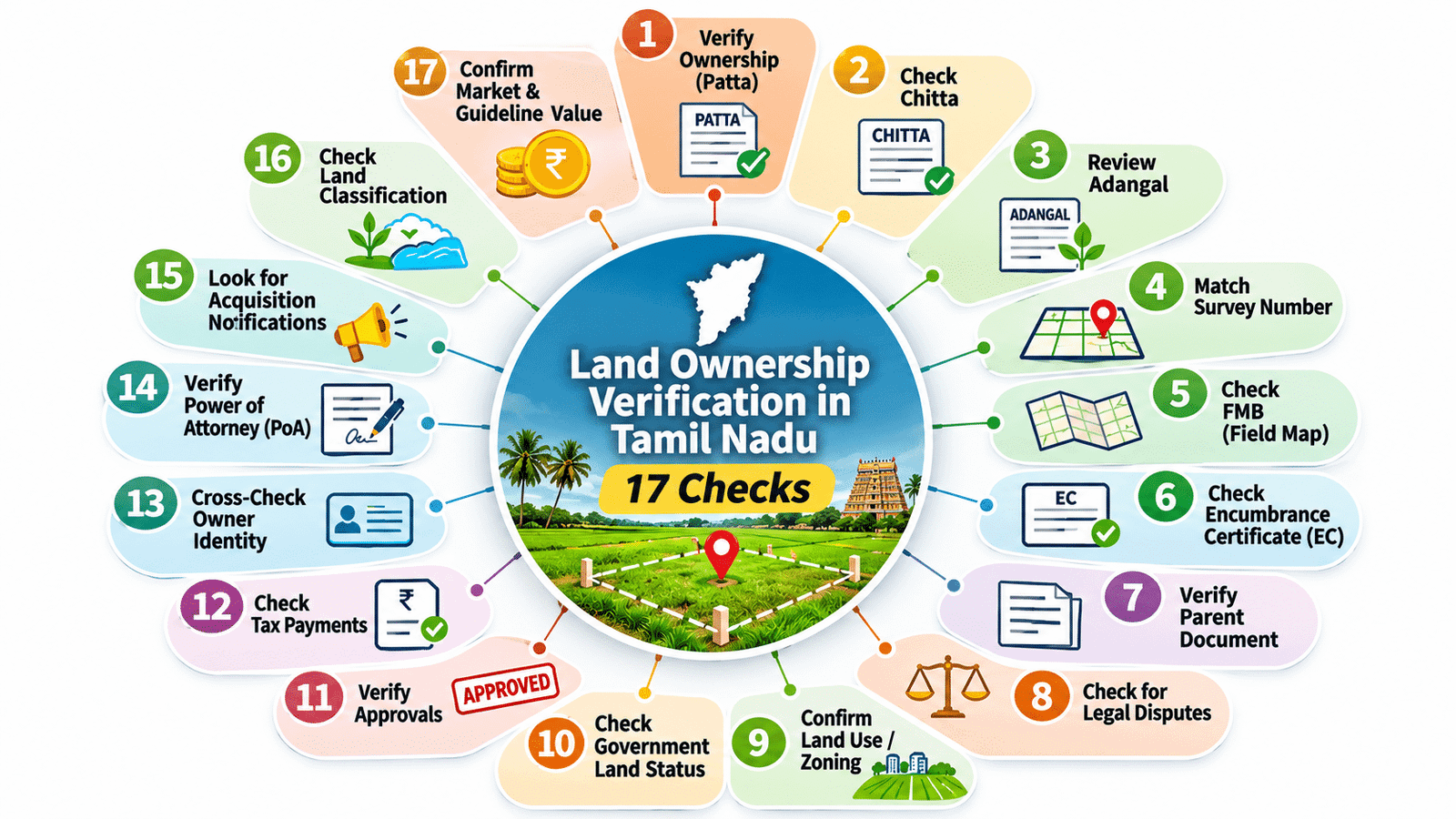
Introduction: Why Land Ownership Verification Matters Before Buying Property in Tamil Nadu
Land ownership verification in Tamil Nadu is one of the most important steps to complete before purchasing a residential plot, agricultural land or property for investment. Before paying an advance or signing a sale agreement, every buyer should establish a basic fact: does the seller legally own the property and have the right to transfer it?
A plot may have an attractive location, convenient road access and a price that fits your budget. However, those advantages do not remove the risk of unclear ownership, missing title documents, conflicting survey details, existing financial claims or disputes. A property purchase should therefore begin with document verification rather than relying only on the seller's explanation or an advertisement.
Verifying land ownership involves reviewing the current title deed, tracing earlier ownership through parent documents, checking the Encumbrance Certificate (EC), comparing applicable Patta and revenue records, confirming survey details and inspecting the physical boundaries. Buyers should also examine the seller's legal authority, possible mortgages, disputes, layout approvals and the permitted use of the land.
The documents required can vary depending on the property's location, history, classification and type of transaction. No single certificate should be treated as complete proof that a property is free from every legal issue. The safest approach is to compare the available records and obtain an independent opinion from a qualified property lawyer whenever necessary.
The purpose of land document verification is simple: confirm who owns the property, whether the seller can legally sell it, and whether the documents accurately describe the land being offered.
1. Obtain and Verify the Seller's Current Ownership Document
Start by asking the seller for the document through which they acquired the property. This is commonly the current registered title document, but ownership may also have been transferred through other legally recognised forms, depending on the circumstances.
Documents may include:
- Registered sale deed
- Gift deed
- Settlement deed
- Partition deed
- Release deed
- Documents relating to inheritance or succession
- Other documents relevant to how the seller acquired the property
Do not depend only on a photograph, summary or photocopy supplied during a sales discussion. Ask for the relevant document details and have the available records checked. Compare the owner's name, property description, survey number, subdivision number, land extent and four boundaries with the property being offered.
If the seller's name does not match the name shown in the ownership documents, ask for the explanation and supporting documents. A name difference should not be ignored or accepted based only on a verbal assurance.
2. Examine the Parent Documents and Chain of Ownership
The latest sale deed may show how the current seller acquired the property, but it may not explain the complete ownership history. Buyers should review the earlier title documents, commonly called parent documents or previous title deeds, as applicable to the property's history.
A chain of ownership may look like this: Owner A transferred the property to Owner B, Owner B transferred it to Owner C, and Owner C later transferred it to the present seller. The purpose of checking this chain is to understand how ownership passed from one person to another and whether the supporting documents are consistent.
Look for unexplained gaps, inconsistent names, different property descriptions, missing links or changes in the survey details. Some differences may have a valid explanation, such as a documented subdivision or a later registered transaction. They should still be clarified and supported by records.
Reviewing the chain of title is a central part of land ownership verification in Tamil Nadu because the current seller's document needs to be understood in the context of earlier transfers.
A property lawyer can review the chain of title, identify documents that may be missing and advise whether further records are required. This review is particularly important when the property has changed hands several times or has a complicated family or inheritance history.
3. Check the Encumbrance Certificate (EC)
An Encumbrance Certificate (EC) is an important part of property document verification. It provides information about certain registered transactions and encumbrances recorded for the property during the period covered by the certificate. Depending on the records, entries may include registered transactions such as sales or mortgages.
When reviewing the EC, compare the following details with the title documents:
- Survey number and subdivision number, where applicable
- Property description and location
- Extent or area of the land
- Names of the parties involved
- Document and registration particulars
- Registered transaction history for the period covered
Check whether the EC refers to the same property described in the seller's documents. An inconsistency in the survey number, extent, party name or transaction details needs clarification before proceeding.
For land ownership verification in Tamil Nadu, read the EC alongside the title deed, parent documents and applicable revenue records instead of treating it as a standalone clearance.
An EC is not an absolute guarantee that no legal issue exists. It reflects registered information within its scope and period; it should be considered alongside title deeds, parent documents, relevant revenue records, legal enquiries and physical verification. Ask a property lawyer to advise on the appropriate period and interpretation for the specific transaction.
4. Verify Patta and Relevant Tamil Nadu Revenue Records
Patta and other applicable revenue records can help buyers compare the seller's details with the land records maintained for the property in Tamil Nadu. The relevant records and details may vary according to the land type and the property's circumstances.
Check the available records for details such as:
- Owner or pattadar name
- Survey number and subdivision number
- Recorded extent of land
- Land classification
- Village and other location details
Compare these details with the title deed and other relevant documents. If the name, survey number, subdivision or extent differs, identify the reason and obtain professional guidance before making payment.
Patta and revenue records are important verification references, but they should not be treated as a substitute for examining the title documents. A name appearing in a revenue record does not, by itself, conclusively establish ownership.
5. Match the Survey Number and Subdivision Number in Every Document
The survey number is a key identifier when verifying land ownership. Buyers must make sure that the documents relate to the exact land being offered, rather than assuming that similar names or nearby locations refer to the same property.
For example, the seller's document may refer to Survey No. 125/3A, while another record may show Survey No. 125/3B. These references should not be treated as interchangeable. A subdivision identifies a particular portion of a larger survey field, so even a small difference may point to a different parcel of land.
Compare survey and subdivision numbers across the sale deed, parent documents, EC, Patta and relevant survey records. If a number has changed because of a documented subdivision or record update, ask for the supporting records and have the change checked by a qualified professional.
Do not proceed on the assumption that a mismatch is only a typing error. Confirm that the land shown during the site visit is the same land described in the legal and revenue records.
6. Inspect the Land and Confirm Its Physical Boundaries
Document verification should be supported by a physical inspection. Visit the exact property and compare what you see on the ground with the measurements and boundary descriptions in the available documents.
Pay attention to:
- North, south, east and west boundary descriptions
- Actual plot dimensions and total extent
- Road frontage and access to the property
- Adjacent plots, land parcels and existing structures
- Boundary markers and any apparent encroachment
- Differences between the site and the document description
Where measurements or boundaries are uncertain, consider arranging a survey through a competent survey professional. A physical survey can help establish whether the land being shown corresponds with the parcel described in the records. It is especially useful when neighbouring boundaries, access routes or plot dimensions are unclear.
7. Review the Field Measurement Book (FMB), Where Applicable
The Field Measurement Book (FMB) and other relevant survey information may help explain the layout, measurements and subdivisions of a survey field. These records can be useful when a buyer needs to understand how a particular parcel sits within a larger land area.
FMB and related survey details may be especially relevant when questions arise about:
- Plot or field measurements
- Survey subdivisions
- Physical boundary positions
- Road access and adjoining land
- Differences in the recorded extent
The relevance and availability of FMB information depend on the property and its records. Ask a survey professional or property lawyer to explain the documents where the measurements or boundary details are not clear. Do not use a sketch or a single survey record as a replacement for complete title verification.
8. Confirm That the Seller Has the Legal Right to Sell the Property
Identifying a person's name in a document is only one part of ownership verification. Buyers must also establish whether the person signing the sale has the legal authority to transfer the property. This needs particular care when ownership involves more than one person or has passed through inheritance.
Additional checks may be needed when:
- The property has multiple or joint owners
- The land was inherited or received through succession
- Other family members or co-owners may have an interest
- A release, partition or settlement document is involved
- A Power of Attorney holder is signing for the owner
- The person selling the property is acting on behalf of someone else
Where a Power of Attorney is involved, have the document and the authority it grants reviewed carefully. If there are several owners, inheritance issues or unresolved succession questions, obtain legal advice on whose consent or participation is required for the proposed transfer.
9. Find Out Whether the Property Has an Existing Mortgage or Financial Claim
Land may have been offered as security for a loan or may be subject to another financial claim. Buyers should review the EC and relevant ownership documents to identify registered mortgage entries or other recorded encumbrances within the available records.
As part of land ownership verification in Tamil Nadu, buyers should understand whether a recorded mortgage or financial claim affects the proposed transfer and what evidence will confirm its release.
If a mortgage or charge exists, understand exactly how it will be discharged as part of the sale. The process should be documented and reviewed before the transaction is completed. Do not rely only on a seller's verbal statement that the loan will be repaid later.
If a bank or other lending institution is involved, its legal team may review the property documents as part of the loan process. That review can be useful, but buyers should still arrange an independent review of the documents and the proposed release process.
10. Check for Pending Legal Disputes and Ownership Claims
Land ownership verification should not stop with a review of registration and revenue records. A property may also be affected by a dispute, a family claim or a legal proceeding that needs separate investigation.
Ask questions and seek appropriate legal checks for issues such as:
- Pending lawsuits relating to the property
- Family or inheritance disputes
- Partition proceedings
- Competing ownership claims
- Boundary or access disputes
- Land acquisition-related issues or other legal proceedings
Ask the seller to disclose known disputes and have any concern investigated independently. A low asking price should not distract you from understanding why the property is being offered at that price. If a lawsuit or claim is suspected, pause the purchase process until a property lawyer explains the nature of the issue and the risks involved.
11. Verify the Layout Plan and Applicable Planning Approvals
If you are purchasing a plot in a residential layout, check the relevant layout plan and applicable planning approval documents. The responsible planning authority or local body can depend on the property's location and the type of development.
Compare the approved plan and its details with the actual layout and the plot being sold. Check whether the plot identification, survey details, dimensions and access shown in the records correspond with the site. Seek professional guidance if the documents are unclear or if the layout on the ground appears different from the plan.
Approval and ownership are two separate questions. A layout approval does not, by itself, prove that the seller owns the land. Likewise, proof of ownership does not automatically establish that a layout or proposed use has the required planning approval.
12. Confirm the Land Classification and Whether It Matches Your Intended Use
Before buying land, understand its recorded nature or classification and consider whether the intended use is permitted under the applicable rules. The checks required for a residential plot may differ from those for agricultural land or another type of property.
For example, a buyer planning to construct a house needs to consider more than the identity of the owner. The buyer should also check relevant land-use, planning and building requirements and confirm whether the proposed use is permissible. Do not assume that land can be used for residential construction simply because nearby houses or layouts are visible.
Ask the appropriate professional or authority to clarify any classification or land-use question before committing to the purchase. The seller's description of the property should be checked against the relevant records.
13. Cross-Check Every Property Document Instead of Reviewing Them Separately
One of the most useful steps in property document verification is to compare all available documents with one another. A document may appear complete when read on its own, while a difference becomes visible only when it is compared with the other records.
Check that the following details are consistent wherever they appear:
- Owner and party names
- Survey and subdivision numbers
- Property description and village details
- Land extent and measurements
- Four boundaries and access details
- Registration particulars and transaction history
- Relevant revenue, survey and approval details
This document-to-document comparison is an essential part of land ownership verification in Tamil Nadu because it helps identify details that need an explanation before the transaction moves forward.
If a difference appears, do not automatically assume that it is an error or that it makes the property invalid. There may be a documented reason, such as a subdivision or a later transaction. Ask for the supporting records and have the discrepancy explained before proceeding.
14. Use Official Registration and Revenue Records for Verification
Wherever available, use the relevant official registration and revenue record services to obtain or verify property information. Do not depend entirely on documents, screenshots or statements supplied by an intermediary when checking land ownership in Tamil Nadu.
Official digital records can help buyers review information and compare details. However, an online search or downloaded record should be treated as one part of due diligence, not as a replacement for reviewing the full title history and the documents relevant to the transaction.
Keep copies of the records reviewed and note the date on which they were obtained. Where a record is missing, unclear or inconsistent, ask the relevant professional how it should be resolved. A property lawyer can assess the records together and advise whether additional certified or supporting documents are needed.
15. Do Not Rush Land Purchase Decisions Because of Limited-Time Offers
Buyers may hear statements such as "another customer is ready to pay", "the price is valid only today" or "pay the advance immediately to block the plot". Such sales pressure should never take priority over ownership and document verification.
A genuine opportunity should still allow reasonable time for the buyer to review the documents, inspect the property and seek professional advice. Paying an advance before clarifying ownership, survey details or existing claims can make a later dispute more difficult to manage.
Complete the necessary checks before making a financial commitment. A short delay for proper verification is preferable to rushing into a property transaction with unresolved questions.
16. Ask an Independent Property Lawyer to Review the Title
Land purchases involve significant financial commitments. An independent property lawyer can examine the title documents, ownership history and relevant records, and can identify issues that may not be obvious to a first-time buyer.
A legal review is particularly important when:
- The property has a long or complicated ownership history
- There are multiple sellers, owners or co-owners
- The property has passed through inheritance or succession
- Other family members may have rights or claims
- A Power of Attorney is being used for the transaction
- Survey numbers, boundaries or measurements are unclear
- There are differences between the available documents
- A mortgage, encumbrance or other financial claim is present
- A dispute, court proceeding or ownership claim is suspected
For reliable land ownership verification in Tamil Nadu, the legal review should consider the documents as a connected record rather than as unrelated certificates.
The objective is not simply to collect a large number of documents. It is to understand what each document establishes, whether the records support one another and whether any issue needs to be resolved before purchase.
17. Land Ownership Verification Checklist Before Buying Property
Use this checklist when comparing plots or other land in Tamil Nadu. The exact documents required will depend on the property and its ownership history, so have the list reviewed by a qualified professional.
- Seller's identity and authority to sell
- Current title deed or ownership document
- Relevant parent documents and chain of title
- Encumbrance Certificate for an appropriate period
- Patta and applicable revenue records
- Survey number and subdivision number
- Recorded land extent and physical measurements
- Four boundaries and legally usable road access
- FMB or other relevant survey information, where applicable
- Mortgage, charge and other encumbrance details
- Pending disputes, succession issues or third-party claims
- Applicable layout and planning approvals
- Land classification and suitability for the intended use
- Consistency across all available documents
- Independent legal review and clarification of discrepancies
Keep a record of the checks completed and the questions that remain unresolved. Do not treat the checklist as a substitute for legal advice; it is a practical way to organise the information needed for a careful purchase decision.
Frequently Asked Questions About Land Ownership Verification in Tamil Nadu
How can I verify land ownership in Tamil Nadu before buying a property?
Start by checking the seller's current title document and relevant parent documents. Compare the ownership history with the Encumbrance Certificate, applicable Patta and revenue records, survey details and physical boundaries. Also check the seller's authority to sell, possible mortgages, disputes and applicable approvals. Ask an independent property lawyer to review the documents before you commit to the purchase.
Which documents should I check before buying land in Tamil Nadu?
The documents may include the current sale deed or other title document, parent documents, Encumbrance Certificate, Patta and relevant revenue records, survey and subdivision details, FMB information where applicable, layout approval documents and records relating to mortgages or other claims. The exact requirements depend on the property's history and type.
Is Patta enough to prove land ownership?
No. Patta and other revenue records are useful references, but they should not be treated as conclusive proof of title on their own. Buyers should examine the title deed, parent documents and other relevant records together and obtain legal advice where needed.
What is an Encumbrance Certificate, and why should buyers check it?
An Encumbrance Certificate provides information about certain registered transactions or encumbrances for the period it covers. Buyers use it as one part of due diligence to review transaction history and compare property details. It is not a guarantee that every possible legal claim or issue will appear in the certificate.
Why are parent documents important when purchasing land?
Parent documents help explain how the property passed from earlier owners to the current seller. Reviewing the chain of ownership can reveal gaps, differences in property descriptions or transactions that need further clarification. A property lawyer can advise which earlier documents are relevant.
What should I do if the survey number differs between documents?
Do not ignore the difference or assume it is a typing error. Ask for supporting records that explain the discrepancy, such as documents relating to a subdivision or record change, and have the details checked by a qualified survey professional or property lawyer before proceeding.
Can I buy land if there is an existing mortgage?
A property with an existing mortgage requires careful review. Understand how the loan or charge will be legally discharged and ensure the release process is properly documented before the sale is completed. Do not rely only on a verbal promise that the seller will repay the loan later.
Does layout approval mean that the seller owns the land?
No. Layout approval and ownership verification are separate checks. Approval of a layout does not, by itself, establish that the seller has valid title to the land. Buyers should independently verify both the ownership documents and the applicable planning approvals.
Should I consult a property lawyer before paying an advance?
It is prudent to obtain legal advice before making a significant financial commitment, especially when the title history is complicated, multiple owners are involved, the property is inherited, a Power of Attorney is used or documents contain discrepancies. A lawyer can explain the risks and identify further checks required for the transaction.
Conclusion: Verify Land Ownership Before You Invest in Property in Tamil Nadu
Land ownership verification in Tamil Nadu should be completed before you commit money to a property purchase. A good location, attractive price, wide road or well-presented layout cannot compensate for unclear ownership or unresolved legal questions. Buyers need to know who owns the land, how the seller acquired it, whether the seller can legally transfer it and whether the records match the actual property.
Review the current title deed and parent documents, check the EC, compare applicable Patta and revenue records, confirm survey and subdivision numbers, inspect the boundaries and investigate mortgages or disputes. For residential layouts, check the relevant planning approvals separately from ownership. Where details do not match, obtain supporting records and professional guidance rather than making assumptions.
You can explore Living Assets Builder's property projects, learn more about our construction services and visit our About Us page to understand the company. For a property-related enquiry, please contact Living Assets Builder.
This article is intended as general property-buying information. Document requirements and legal outcomes depend on the facts of each property and transaction. It is not a substitute for an independent title opinion or advice from a qualified property lawyer.
Before you purchase land, confirm who owns it, how ownership was acquired and whether the seller has the right to transfer it. Careful document checks, physical verification and independent legal advice can help you make a more informed property decision.