
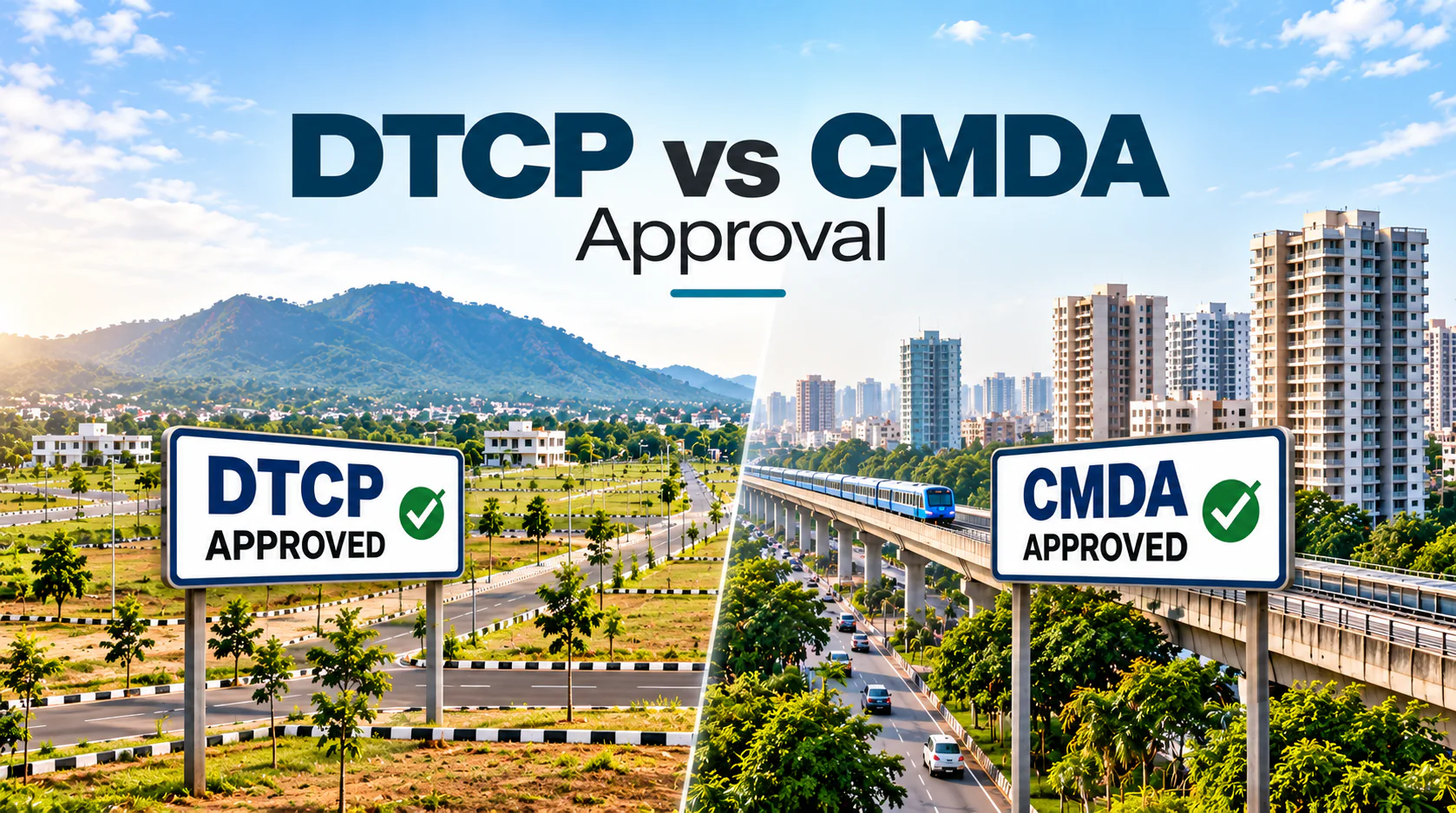
DTCP vs CMDA Approval in Tamil Nadu: Start With the Property's Location
DTCP vs CMDA approval in Tamil Nadu is an important distinction for anyone buying a plot, layout or property. The correct planning authority depends on the property's exact location and the applicable planning jurisdiction—not on the wording used in a brochure. Before paying an advance, verify the approval number, approved plan, survey details and title documents independently.
Property listings commonly use phrases such as “DTCP approved” and “CMDA approved”. First-time buyers may assume that one approval is automatically better than the other. That is not the right way to compare properties. DTCP and CMDA operate under the Tamil Nadu town-planning framework, but their planning responsibilities apply to different jurisdictions. The relevant authority must be identified for the exact land parcel.
The distinction matters because Chennai Metropolitan Area boundaries have changed. The Government of Tamil Nadu approved an expansion of the Chennai Metropolitan Area from 1,189 square kilometres to 5,904 square kilometres through G.O. Ms. No. 184 dated 21 October 2022. Therefore, older articles and property advertisements that refer only to the earlier metropolitan boundary may be out of date. Read the CMDA policy note on the expanded Chennai Metropolitan Area and verify the parcel against the applicable official boundary and records.
This guide explains what DTCP and CMDA mean, how their jurisdictions differ, what “approved layout” should mean to a buyer, and how to verify planning approval before purchasing property in Tamil Nadu. It also explains why planning approval is only one part of legal due diligence.
The most useful question is not “Which approval is better?” It is “Which planning authority has jurisdiction over this exact survey number, and can the approval be verified against the approved plan?”
1. What Does DTCP Approval Mean in Tamil Nadu?
DTCP stands for the Directorate of Town and Country Planning, Tamil Nadu. It functions under the State's Housing and Urban Development administration and carries out statutory planning functions under the Tamil Nadu Town and Country Planning Act, 1971.
DTCP's work includes preparing and implementing regional and local plans, examining development proposals and processing planning permission or layout-related matters in areas that fall within its jurisdiction. Its planning role is not simply to place an “approved” label on a property. Planning review considers how land is proposed to be developed and whether the proposal is consistent with the applicable plan and development regulations.
When a seller describes a plot as DTCP approved, ask for the actual approval proceedings and approved layout plan. Do not rely only on a brochure, a site board, a WhatsApp message or a verbal assurance. The approval should relate to the same survey numbers, village, layout, plot number and dimensions as the land being offered to you.
Before proceeding, ask the seller or developer for the following details:
- Which planning authority issued the approval?
- What is the approval or proceedings number and date?
- Which village, survey numbers and subdivisions are covered?
- Does the approved plan show the exact layout and plot being marketed?
- Are the road areas, open spaces and other conditions shown as approved?
- Can the approval be checked through the relevant government portal or authority?
You can review the State's Tamil Nadu Single Window Portal for Planning Permission and the official Tamil Nadu Town and Country Planning portal for relevant services and information. Portal facilities and the records available for a particular application may vary; contact the competent office if a record cannot be found online.
2. What Does CMDA Approval Mean?
CMDA stands for the Chennai Metropolitan Development Authority. It is the statutory planning authority for the Chennai Metropolitan Area (CMA), operating under the Tamil Nadu Town and Country Planning Act, 1971 and the planning framework applicable to that area.
CMDA's responsibilities include metropolitan planning, land-use planning and development control within its notified planning area. Depending on the type of development and the powers delegated under the applicable rules, a planning-permission application may be handled by CMDA or by the relevant local body. This is why buyers should identify both the planning jurisdiction and the authority competent to deal with the particular approval.
A property advertisement that says “CMDA approved” is not enough. Ask for the approval number, date, approved plan, survey numbers and conditions. Compare those details with the sale documents and the physical property. If the layout has been revised, confirm that the version provided to you is the sanctioned version and not an earlier or merely proposed drawing.
The official Chennai Metropolitan Development Authority website provides planning information and services. For an application or approval handled through the State's unified system, also check the Tamil Nadu Single Window Portal.
CMDA jurisdiction should be checked against the current notified metropolitan boundary. It should not be assumed from a property's postal address, district name or the way a real-estate advertisement describes the locality.
3. DTCP vs CMDA: What Is the Main Difference?
The main distinction between DTCP and CMDA is their planning jurisdiction and the statutory planning framework that applies to the land. They are not competing quality labels, and the words “DTCP” and “CMDA” should not be used as a simple rating of a plot.
DTCP – State Planning Jurisdiction Outside the CMA
The Directorate of Town and Country Planning carries out planning functions in the parts of Tamil Nadu that fall within its jurisdiction outside the Chennai Metropolitan Area, subject to the applicable local planning arrangements and delegated powers.
CMDA – Chennai Metropolitan Area
The Chennai Metropolitan Development Authority is the statutory metropolitan planning authority for the notified Chennai Metropolitan Area. The CMA boundary was expanded to 5,904 square kilometres under G.O. Ms. No. 184 dated 21 October 2022, so older references to the former 1,189-square-kilometre boundary need to be treated with care.
There is also an important practical point: within a planning area, certain categories of planning permission or building permission may be processed by a local body under delegated powers. The competent authority can depend on the development type, building category, location and current delegation. Do not assume that every application in the CMA is processed at the same office.
DTCP and CMDA are not a “good approval versus bad approval” comparison. First establish the exact planning jurisdiction, then verify the approval issued by the competent authority.
4. Is CMDA Approval Better Than DTCP Approval?
It is a common misconception that a CMDA-approved property is automatically safer or more valuable than a DTCP-approved property. The reverse assumption—that a DTCP-approved property is inferior—is also misleading.
The correct approval depends on the property's location and the applicable planning jurisdiction. A genuine approval issued by the competent authority for the correct land and development is what matters. The authority's name alone does not establish that the seller has a valid title, that the plot boundaries are correct or that there are no legal claims affecting the land.
A buyer should compare the actual property rather than the approval label. Check the approved layout, land use, access roads, plot dimensions, open-space reservations, conditions imposed by the authority and whether the marketed plot appears in the sanctioned drawing.
Even a genuine planning approval does not remove the need to verify ownership, parent documents, encumbrances, land classification, survey records and the seller's authority to transfer the property. Those are separate checks that should be carried out by an independent property lawyer and, where needed, a licensed survey professional.
Do not choose a plot because its advertisement uses the words “CMDA approved” or “DTCP approved”. Choose only after you have verified the correct approval and completed the other legal and site checks.
5. Why Is Layout Approval Important When Buying Land?
Layout approval is an important part of responsible land development. It records the planning authority's decision on a proposed layout under the applicable rules and conditions. The approved plan can help a buyer understand the layout's sanctioned roads, plots, open spaces and other planning features.
For a plot buyer, the key task is to confirm that the actual land being sold is included in the approved layout and that the approval has not been misrepresented. A seller may show a plan for a larger development while marketing a plot that is not covered by that approval. Compare the plot number, survey numbers, dimensions and boundaries carefully.
Approval is not the same as a legal title certificate, an encumbrance-free guarantee, a building permit or confirmation that every utility is available. Planning approval and ownership verification address different issues. A building proposal may also require a separate building permission from the competent authority before construction begins.
Treat layout approval as one essential part of due diligence—not as proof that every legal, financial and construction issue has been resolved.
6. Documents to Check Before Buying a DTCP or CMDA Approved Plot
The documents required can vary with the land type, location, seller and transaction. Ask an independent property lawyer to prepare a document checklist for the specific plot. Do not assume that one certificate is sufficient for every purchase.
Ownership and Parent Documents
Confirm who owns the land and whether the person signing the sale agreement has the legal authority to sell it. Have the parent documents and chain of title reviewed for gaps, inheritance issues, partitions, releases or other matters relevant to ownership.
Encumbrance Certificate
Obtain an Encumbrance Certificate for the relevant period and have a lawyer interpret it along with the title documents. An EC is a useful search record, but it should not be treated as a complete guarantee that no claim, dispute or unregistered issue exists.
Approved Layout and Planning Permission
Obtain the full approval proceedings and sanctioned layout plan. Check the authority, approval number, date, survey numbers, plot number, road details, dimensions and conditions. Confirm that the plot being sold is actually covered by the approved plan.
Patta, Survey and Revenue Records
Review the applicable patta, chitta, A-register, Field Measurement Book or other revenue and survey records, as relevant to the land. Compare the records with the sale deed and the physical site; ask a qualified surveyor to resolve measurement or boundary discrepancies.
Land Use, Access and Other Restrictions
Verify the permitted land use, legal access, road width, waterbody or government-land issues, acquisition notifications, easements and other restrictions that may affect the proposed use. A lawyer or planning professional can advise which checks are relevant to the property.
The Tamil Nadu Registration Department portal provides registration-related services. The Tamil Nadu Single Window Portal for Planning Permission provides access to planning-permission services. Use official records and obtain professional interpretation where needed.
7. Do Not Confuse a Property Advertisement With an Official Approval
Real-estate advertisements often use phrases such as:
- “DTCP Approved Layout”
- “CMDA Approved Plot”
- “Fully Approved Residential Layout”
- “Ready for Registration”
These phrases are marketing statements until they are supported by the relevant official documents. A brochure, social-media post, site board or message from a salesperson is not a substitute for the approval proceedings and approved plan.
Ask for copies of the approval documents and check them independently. Make sure the documents refer to the exact village, survey numbers, subdivision, layout and plot you are considering. Check whether the plan is final and sanctioned, rather than a draft, application receipt or proposal awaiting approval.
Do not rely only on:
- Verbal assurances from the seller or broker
- Promotional brochures and sales presentations
- Social-media posts or website descriptions
- WhatsApp messages and screenshots without verifiable records
- A board displayed at the site
- An approval document for a different survey number or layout
- A registration document that does not establish planning approval
Property purchases involve significant savings. If an approval number cannot be verified, or the approved drawing does not match the plot being sold, pause the transaction and seek clarification from the competent authority and your lawyer.
If an approval claim influences your buying decision, ask to see the official record that proves it.
8. Which Approval Applies to Guduvancheri and Nearby Areas?
Buyers looking at Guduvancheri should pay particular attention to the notified Chennai Metropolitan Area boundary. Guduvancheri is named in a government-published list associated with the earlier expansion of the Chennai Metropolitan Area. The later expansion approved under G.O. Ms. No. 184 dated 21 October 2022 increased the CMA area to 5,904 square kilometres.
This means older advice that treats Guduvancheri as automatically outside the metropolitan planning area may be out of date. However, do not decide the authority for a particular plot from the locality name alone. Match the exact village, survey number and parcel boundary against the current official planning maps and records. Nearby places can have different administrative or planning details.
For context, the government-published Chennai Metropolitan Area expansion document lists Guduvancheri among the included places. The CMDA policy note describes the subsequent expansion from 1,189 to 5,904 square kilometres. These are useful starting references, but a buyer should still verify the exact parcel against current official records.
Before asking whether a Guduvancheri plot is “DTCP or CMDA”, identify the revenue village and survey details, then confirm which planning authority is competent for that exact land and development. Where a local body exercises delegated powers, confirm the authority that processed or issued the particular permission.
For Guduvancheri property, never rely on an old jurisdiction description or the neighbourhood name alone. Verify the exact survey number and approval with the current official records.
9. Planning Approval Is Only One Part of Property Due Diligence
Imagine that you find a plot at an attractive price. The site appears accessible, the seller shows an approved layout and the location seems suitable for your family. Those are useful starting points, but they are not enough to make a safe purchase decision.
You must also determine whether the seller has a clear and transferable title, whether the land description matches the site, whether any registered encumbrances or disputes need attention, and whether the land can legally be used for your intended purpose.
Check physical features as well: approach road, boundaries, measurements, drainage, waterlogging, electricity access and surrounding land use. If the plot is part of a layout, confirm that the approved plan and the land on the ground match.
An approval certificate is not the end of due diligence. It is one document in a wider legal, planning and physical verification process.
Do not pay a substantial amount until the key checks are complete and any unresolved issues have been reviewed by qualified professionals.
10. Does DTCP or CMDA Approval Guarantee a Bank Loan?
No. A DTCP or CMDA planning approval does not automatically guarantee that a bank or housing finance company will provide a loan for the property. Lenders carry out their own legal, technical and financial assessment.
A lender may consider the borrower's income, credit profile, existing liabilities, repayment capacity and age. It may also examine the property's location, title, approval status, valuation, access and whether the land meets the lender's product conditions.
Different lenders may have different rules for vacant residential plots, land purchase, plot-and-construction finance and construction on land already owned. Ask the lender to confirm the product, required approvals, margin contribution, loan-to-value limit, tenure, interest rate, fees and construction conditions in writing.
Do not treat a seller's statement that “bank loan is available” as a loan sanction. Ask which lender has assessed the property, whether the assessment relates to the exact plot and whether the approval is current. Even a preliminary eligibility indication is not the same as a final sanction and disbursement.
Loan availability must never replace your own property due diligence. A lender's legal review is carried out for its lending decision and does not remove the buyer's responsibility to obtain independent legal advice.
11. Why Independent Legal and Planning Verification Matters
Property documents can contain technical descriptions, survey references, conditions and historical transactions that are difficult for a first-time buyer to interpret. Recognising the name of a document is not the same as understanding what it establishes or what it leaves unverified.
An independent property lawyer can review the title chain, sale documents, encumbrances, seller's authority and relevant legal restrictions. A licensed surveyor or qualified technical professional can help compare the survey records, measurements, boundaries and physical site. A planning professional can help identify the applicable jurisdiction and approval conditions.
Independent advice is especially useful where there are:
- Multiple owners, inherited property or a partition history
- Gaps or inconsistencies in parent documents
- Differences between survey records and site measurements
- Unclear layout approval or planning jurisdiction
- Questions about land classification, access or restrictions
- Existing claims, disputes or unusual encumbrance entries
- Large financial commitments or a complicated transaction structure
It is usually more practical to identify and resolve a documentation issue before signing or paying than to face a dispute after the purchase. Choose advisers who are independent of the seller and who can explain the basis for their conclusions.
12. DTCP and CMDA Approval Verification Checklist for Property Buyers
Use this checklist when comparing a DTCP-approved or CMDA-approved plot in Tamil Nadu. Keep copies of the records you review and note any questions that need confirmation from the authority or your lawyer.
Step 1: Identify the Exact Property
Record the district, taluk, village, local body, survey number, subdivision, plot number and boundaries. Do not rely only on the locality name in the advertisement.
Step 2: Confirm the Planning Jurisdiction
Check the current notified planning-area boundary and identify whether DTCP, CMDA or a local body exercising the relevant delegated power is competent for the proposal.
Step 3: Obtain the Approval Proceedings
Ask for the approval number, date, issuing authority, sanctioned plan and all conditions. Distinguish a final approval from an application receipt or draft plan.
Step 4: Match the Approved Plan to the Plot
Match survey numbers, subdivisions, plot number, dimensions, boundaries, access roads and open spaces against the sanctioned drawing and the site.
Step 5: Verify Ownership and Title
Have an independent lawyer review the parent documents, chain of title, seller's authority and all relevant ownership records.
Step 6: Review Encumbrance and Revenue Records
Check the relevant Encumbrance Certificate, patta and survey records, land classification and any other records relevant to the parcel.
Step 7: Inspect the Site and Access
Visit the property, verify its boundaries and road access, inspect drainage and surroundings, and obtain a survey check if measurements are uncertain.
Step 8: Confirm Building and Loan Requirements
If you plan to build or borrow, separately confirm the required building permission, lender eligibility, valuation, own contribution and repayment terms.
Step 9: Review the Sale Agreement
Ask your lawyer to check the property description, price, advance, payment schedule, registration terms, conditions and safeguards before you sign.
Step 10: Proceed Only After Issues Are Resolved
Do not proceed while material differences in approval, title, survey details or access remain unexplained. Obtain written clarification where appropriate.
13. Common Mistakes to Avoid When Checking DTCP or CMDA Approval
Buyers can become focused on a property's price, location or advertised approval and overlook important checks. Avoid these common mistakes when purchasing land in Tamil Nadu.
Assuming One Approval Is Always Better
DTCP and CMDA relate to different planning jurisdictions. Confirm the correct authority for the exact property instead of ranking the names as competing quality labels.
Using an Old Jurisdiction Map
Chennai Metropolitan Area boundaries have expanded. Do not rely on older information that describes only the former metropolitan boundary; check current official notifications and maps.
Accepting a Brochure as Proof
Marketing material is not an approval proceeding. Obtain the official approval number and sanctioned plan, and verify that they cover the plot being sold.
Assuming Planning Approval Proves Clear Ownership
Planning approval and title verification are different checks. Have the ownership chain, seller's authority and encumbrance details reviewed independently.
Assuming Approval Guarantees a Bank Loan
Lenders have their own eligibility, title, valuation and property conditions. Obtain confirmation for the exact plot and loan product rather than relying on a verbal promise.
Ignoring the Physical Site
A sanctioned plan does not tell you everything about the current condition of the plot. Inspect access, measurements, drainage, boundaries and surrounding land use.
14. What Should a Smart Property Buyer Remember?
Whether you are buying a first plot, planning a home for your family or considering a property investment, keep these principles in mind:
- DTCP and CMDA are planning authorities with different statutory jurisdictions; they are not competing quality grades.
- The applicable jurisdiction must be checked against the exact location, village and survey details.
- The Chennai Metropolitan Area boundary expanded to 5,904 square kilometres under G.O. Ms. No. 184 dated 21 October 2022.
- Guduvancheri is named in a government-published CMA expansion list, so older advice about its jurisdiction should be checked carefully.
- The approval number and sanctioned plan must match the land and plot being marketed.
- Planning approval does not replace independent title, ownership, encumbrance and revenue-record verification.
- Building permission and lender approval are separate matters and may have additional requirements.
- Independent legal and technical advice can help identify issues before you commit funds.
Conclusion: Verify the Correct Planning Approval Before Buying Property
Understanding DTCP vs CMDA approval in Tamil Nadu helps property buyers ask better questions before purchasing a plot or layout. The key difference is the planning jurisdiction that applies to the land, not a simple ranking of which approval sounds more valuable.
Because Chennai Metropolitan Area boundaries have expanded, buyers should avoid relying on older jurisdiction descriptions. This is particularly important when considering property in and around Guduvancheri. Identify the exact village and survey number, check the current planning-area boundary and confirm the competent authority for the specific development.
Request the approval proceedings and sanctioned layout plan, compare them with the actual plot, and independently verify the chain of title, encumbrances, survey details, land records and seller's right to sell. If you intend to construct a house, confirm the separate building-permission requirements. If you plan to use a loan, check the lender's requirements for the same property.
Take your time, compare the documents with the site and seek professional advice whenever something is unclear. If you are exploring residential plots or property options, you can review Living Assets Builder's projects and contact the team through the property enquiry page for project information. Any purchase should still be subject to your own legal and technical verification.
“The right approval is the one issued by the competent authority for the exact land. Verify the plan, verify the title and understand the property before you invest.”